

Download the data-driven guide to AI adoption, governance, and trust in HR.
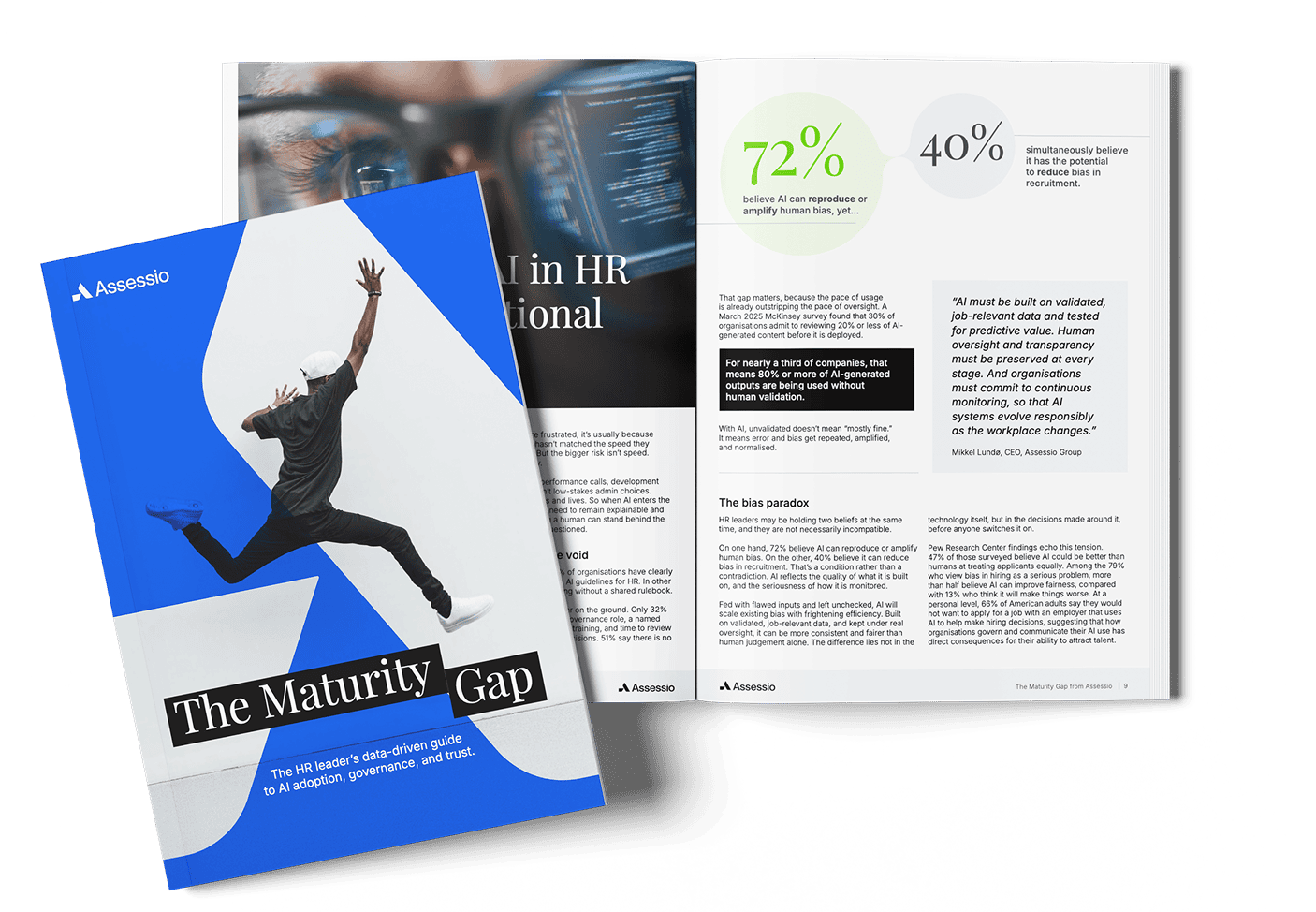
AI adoption in HR is accelerating, and governance isn’t keeping pace. This report, based on a survey of HR leaders across Europe and leading industry research, examines the gap between ambition and reality — and identifies what it takes to close it responsibly.
What’s inside
A detailed analysis of where HR organisations stand on AI maturity, governance, and trust, alongside practical guidance for HR leaders, business partners, and L&D teams on what to audit, what to fix, and how to prepare for the EU AI Act.
Key insights
The data reveals a sector accelerating AI adoption without the maturity to match. Here are three findings every HR leader should know about.
96%
of employees already have personal access to generative AI tools
Yet 47% of HR leaders say their organisation is moving too slowly on AI implementation.
83%
of HR functions are still operating at the lowest levels of AI maturiry
Moving beyond isolated tasks requires more than access to AI tools. It requires the governance and foundations to integrate them into decisions that actually matter.
61%
of organisations lack clearly defined AI guidelines for HR
Without a shared rulebook, AI adoption moves faster than accountability. The organisations that govern AI well have processes and people to keep it in check.
Built on research,
not assumption
The Maturity Gap draws on a 2026 survey of HR and people leaders across Europe, alongside a review of recent research from McKinsey, Gartner, the Josh Bersin Company, and Pew Research Center.
For HR leaders who want to get ahead
Whether you’re building a governance framework or reviewing tools, get the practical steps to move forward with confidence.
“When bias gets embedded in a system that runs at scale, it doesn’t show up as noise. It shows up as a pattern, and a pattern is much harder to see and correct than an individual mistake.”
— Mikkel Lundø, CEO, Assessio Group
Download the
white paper now
Get your free copy and join the conversation
Frequently asked questions
The gap between how fast organisations are adopting AI in HR and how slowly they are governing it. Our survey found that 74% of HR leaders expect AI to improve their working environment — yet 61% lack clearly defined AI guidelines and 51% have no governance role at all. The ambition is real. The infrastructure to match it largely isn’t.
AI maturity is the degree to which an organisation uses AI effectively, consistently, and with appropriate oversight. Most HR functions are stuck at the lowest level, using AI only for isolated tasks rather than integrating it into decisions that shape real outcomes. Maturity matters because without it, organisations accumulate risk without realising the benefits.
Start with three questions: does your AI predict actual job performance? Would the same candidate receive a consistent result over time? Are the insights genuinely job-relevant? Beyond the tool itself, assess whether your organisation has clearly defined AI guidelines, a named person with authority to review AI-driven decisions, and a process for monitoring bias in practice.
The EU AI Act sets out binding obligations for organisations that deploy AI in recruitment, screening, and performance management. Crucially, these obligations cannot be transferred to your vendor. They include trained oversight personnel, impact assessments, worker notification, and decision logging. Worker consultation requirements are already enforceable, with full high-risk obligations targeted for August 2026.
In practice, it means having a named person with the authority and time to review and override AI-driven decisions, guidelines that people actually follow, and tools that are monitored for bias continuously — not just at deployment. Our data shows that organisations with genuine governance infrastructure are more than twice as likely to provide formal AI training and significantly more likely to actively monitor for bias.
Three things: validity (does the tool actually predict job performance?), consistency (would the same candidate receive the same result on a different day?), and differential impact (does the tool perform differently across demographic groups?). Most HR AI tools are not built with this level of rigour. The report explains what to look for and what to ask your provider.
It sets out what Article 26 requires of deployers in plain language, explains the distinction between provider and deployer liability, and gives HR leaders a clear picture of where most organisations currently fall short. It also includes practical recommendations tailored to CHROs, HR business partners, and L&D leads, so you know exactly where to focus.
HR leaders, HR business partners, L&D teams, and people analytics professionals – particularly those using or planning to use AI in recruitment, performance management, or development. The final section includes role-specific guidance, and the report is structured so readers who go straight to the recommendations still get everything they need to act.


